
Urban October 2026: A Closer Look at Oman's Urban Transformation
From 5 to 9 October, GBD Innovation Club took part in Urban October 2026, organised by the Ministry of Housing and Urban Planning of the Sultanate of Oman (MoHUP). The programme combined international discussions on urban development with a closer look at the projects currently shaping Muscat and other cities across the country.
The programme offered a closer look at Oman’s major urban development projects, from the Greater Muscat Structure Plan to Al Khuwair Downtown, alongside discussions with international experts on economic development, urban planning and the management.
The programme opened with World Habitat Day, celebrated in partnership with UN-Habitat. The ceremony included the UN-Habitat Scroll of Honour Awards, presented by Anacláudia Rossbach, UN Under-Secretary-General and Executive Director of UN-Habitat, and the announcement of major development agreements. H.E. Dr. Khalfan bin Saeed Al-Shuaili, Minister of Housing and Urban Planning, subsequently inaugurated the Urban October exhibition.
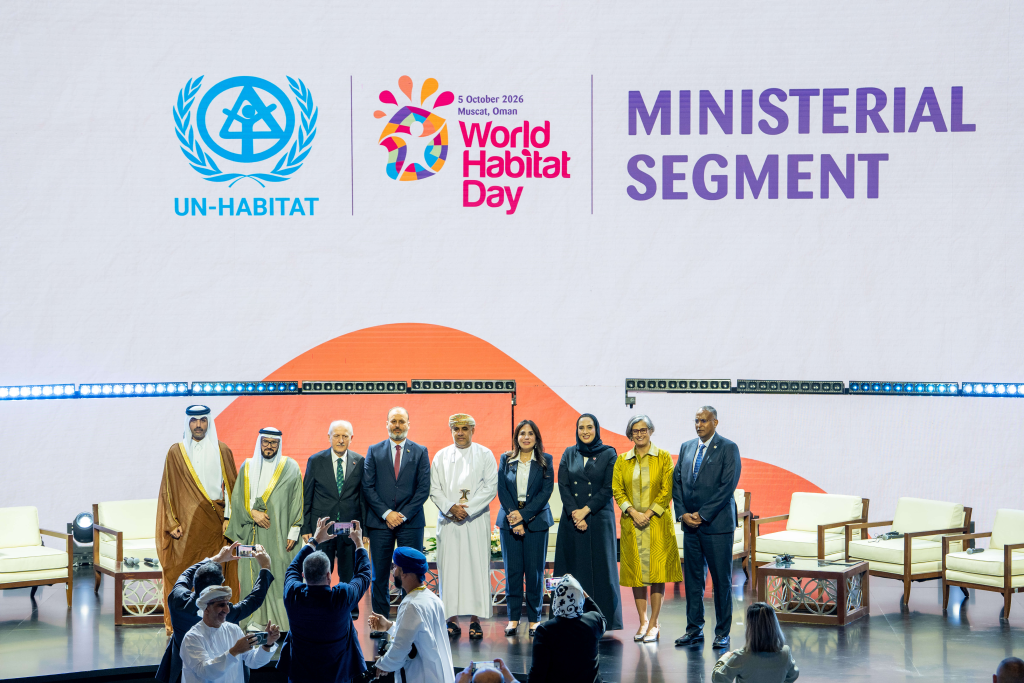
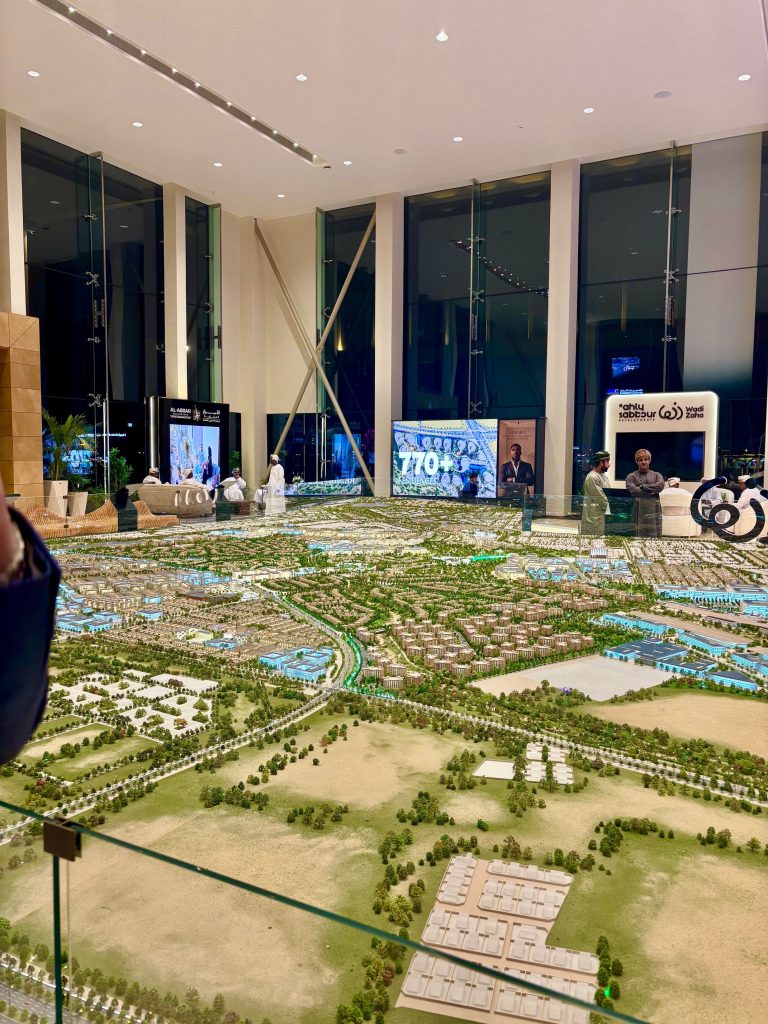
A presentation of the Greater Muscat Structure Plan by Nasser Al Sayegh, Technical Director of the project, provided an overview of the capital’s development strategy towards 2040. The metropolitan model illustrated the scale of the planned transformation and the relationship between new development areas, infrastructure and the existing urban fabric.
The delegation also explored projects including A’Thuraya and Salalah New City, and learned more about Al Khuwair Downtown, Sur and Jabal Al Aali through presentations by the Ministry’s planning teams.
Two projects illustrate the diversity of approaches being developed in Oman. Al Khuwair Downtown is planned as a new waterfront business, commercial and leisure destination, connected to one of Muscat’s future transit-oriented development hubs. A’Thuraya proposes a residential development shaped by the natural topography, with neighbourhoods organised around views of the coastline, mountains and surrounding landscape.
For international business district managers, these projects raise practical questions. How should a new district be governed once construction is complete? Who is responsible for its commercial activity, public spaces and everyday management? And how can new urban centres develop an identity and economic life of their own rather than functioning simply as collections of buildings?
The programme also included an exchange with Invest Oman, represented by Abdulaziz Al Fadhi, on investment opportunities and the country’s economic development priorities. The first day concluded with a gala dinner at the Sultan Haitham City Experience Centre, bringing together Omani hosts and international participants around another major urban development project.
International examples were also part of the conference discussions. Dr Inhee Kim, Chief Masterplanner of Seoul and a key architect of the city’s urban growth strategies, presented the 10-minute city concept and the Seoul 2030 Plan. His presentation was followed by a discussion with Arnoud Molenaar, former Chief Resilience Officer of Rotterdam, moderated by Monika Bik, Planning Advisor to MoHUP.
The Seoul example is particularly relevant when considering the expansion of Greater Muscat. A city cannot become more accessible through transport infrastructure alone. The distribution of housing, jobs, services and public facilities also determines how people move and how much time they spend travelling. For a metropolitan area planning new development corridors, these decisions need to be considered together.
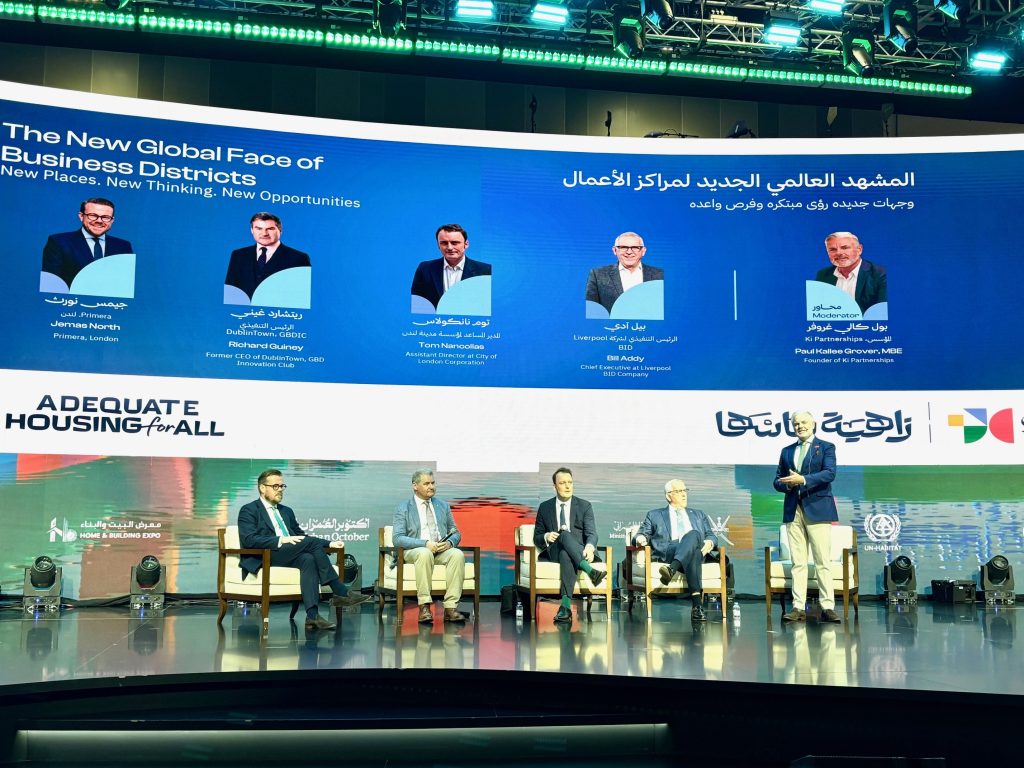
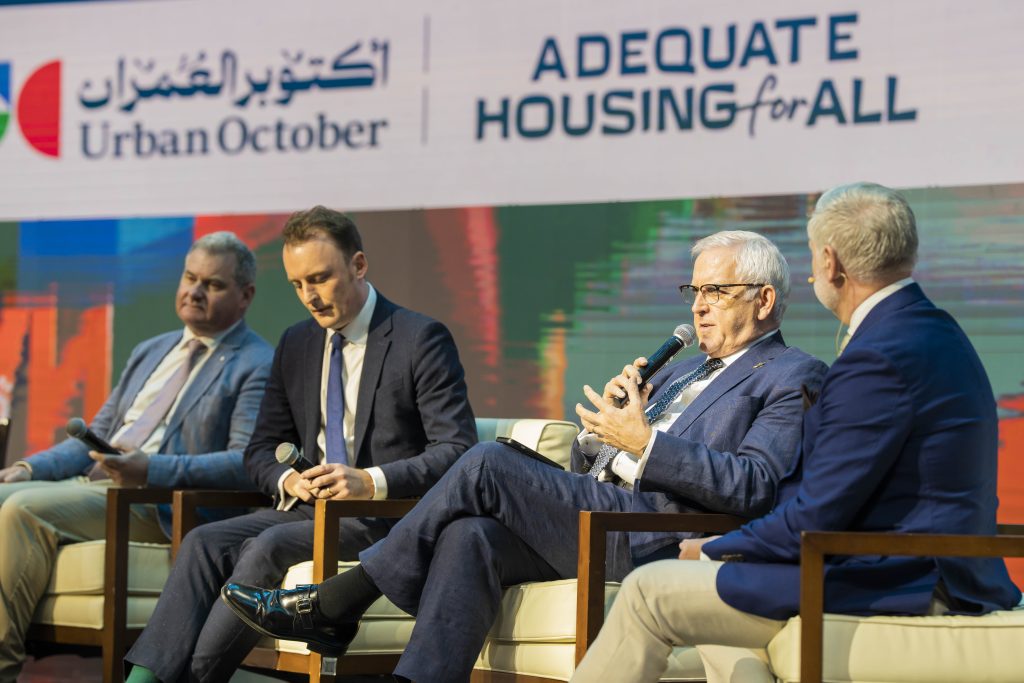
On 7 October, GBD Innovation Club contributed to the main conference programme with “The New Global Face of Business Districts: New Places. New Thinking. New Opportunities,” moderated by Paul Kallee-Grover MBE, Founder of Ki Partnerships.
The panel brought together Bill Addy, Chief Executive of Liverpool BID Company; James North, Primera Corporation, London, UK; Richard Guiney, former CEO of DublinTown and the GBD Innovation Club Executive Committee member; and Tom Nancollas, Assistant Director at the City of London Corporation.
Their professional experiences cover different approaches to managing established urban centres. Liverpool’s Business Improvement District model is based on cooperation with the local business community, with activities extending beyond commercial promotion to public spaces, events and the wider city-centre experience. DublinTown offers experience in collective district management and the relationship between commercial activity and the identity of the city centre.
London provides another perspective, combining the management of one of the world’s leading financial centres with the challenges of a much wider metropolitan business and cultural environment. Through Primera, James North also brings experience of managing and coordinating Business Improvement Districts across central London.
The panel addressed how changes in working patterns, technology, investment and expectations from businesses and talent are affecting the role of business districts. Established centres increasingly need to offer more than a concentration of offices. Public space, cultural activities, accessibility, services and the relationship with surrounding neighbourhoods are becoming important elements of their economic positioning.
For Al Khuwair Downtown, the relevance of these experiences lies not in reproducing the Liverpool, Dublin or London models, but in understanding which management structures and approaches could be considered from the outset. New districts have the advantage of being able to integrate some of these lessons during their development rather than addressing them decades later.
Another important part of the programme focused on Muscat’s economic cluster strategy. Exchanges with representatives of the Ministry of Economy and MoHUP examined the Greater Muscat Structure Plan’s ambition to support a transition towards more productive and knowledge-based sectors through 15 economic clusters.
The discussions covered the spatial organisation of these clusters, their economic specialisations, governance arrangements and implementation challenges. A dedicated session also examined the development of sports-related clusters, including opportunities around Al Amerat.
This approach connects urban planning with economic development in a concrete way. Rather than considering business districts as isolated real estate projects, it raises the question of how infrastructure, investment, specialised industries and talent can be brought together within a coherent metropolitan strategy.
On 8 October, the Club contributed to a second discussion, “The Art of the Possible: Lessons for Muscat,” moderated by Julia Solodova, GBD Innovation Club.
The panel brought together Lama Al Khudhuri, Urban Planner at MoHUP; Ali Mangera, co-founder of Mangera Yvars Architects; and David Howarth, co-founder of DRDH Architects.
The discussion approached urban development through two connected subjects: identity and everyday life, followed by new possibilities for planning, architecture and sustainability.
Muscat’s geography makes the question of identity particularly interesting. Mountains, coastline, historic neighbourhoods and local traditions have shaped the city’s development. As new urban centres emerge, the challenge is not simply to preserve individual historic buildings or introduce recognisable architectural references, but to understand how these elements influence the experience of the city.
The speakers explored how planning and design decisions affect the way people live, move and interact with their surroundings. They also considered how international approaches might be adapted to Muscat’s particular environmental and cultural conditions.
The discussion concluded with an exercise looking towards Muscat in 2050: each speaker was invited by Julia to imagine an idea they would like to see realised and describe what people would actually experience in the city if it became reality.
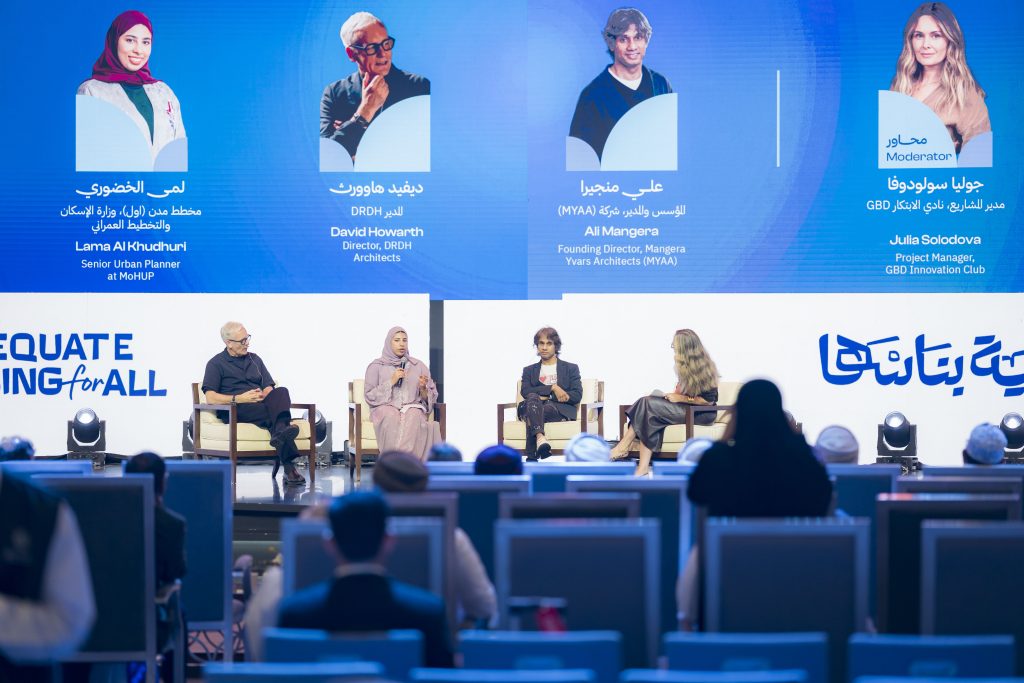
It was an opportunity to move beyond master plans and architectural images and consider the practical consequences of decisions being made today.
For GBD Innovation Club, Urban October was also an opportunity to examine how international cooperation between cities and districts can become more operational.
Since its creation in 2018, the Club has facilitated exchanges between the organisations responsible for developing and managing major business districts. These discussions have traditionally focused on strategies, governance models, investment and urban attractiveness. Today, we see an additional opportunity: bringing together the professionals working directly on urban projects and district management to exchange methods, compare specific cases and develop practical solutions.
The experience of an established district may be useful to a new development, but the reverse is equally true. Emerging districts offer opportunities to test approaches to mobility, mixed-use development, environmental performance and governance that can be more difficult to introduce into an existing urban environment.
The programme in Muscat, combining conference discussions, project presentations, investment meetings and exchanges with the Ministry’s technical teams, provided a useful basis for identifying where this cooperation could develop.
Our sincere thanks to H.E. Dr. Khalfan bin Saeed Al-Shuaili, Minister of Housing and Urban Planning of the Sultanate of Oman, and his team, particularly Nasser Al Sayegh, Monika Bik and the Greater Muscat planning teams, as well as the Urban October organisers, speakers and partners for their warm hospitality, the quality of the programme and the opportunity for valuable exchanges.
We look forward to continuing our cooperation with the Ministry of Housing and Urban Planning of Oman, a member of GBD Innovation Club, particularly on district governance, economic clusters and the operational experience of the Club’s international network.